Alessandro Volta was born in Como in 1745 and died there in 1827. In 1800 he announced the battery.
The town hosted the Volta Exhibition in 1899, which reopened after a fire, and the International Congress of Physicists in 1927. The Tempio Voltiano, inaugurated on the lakefront in 1928, also belongs to the commemorations of the centenary of his death.
In a letter dated 20 March 1800, Alessandro Volta announced a new apparatus to Sir Joseph Banks, president of the Royal Society in London: he called it an artificial electric organ and compared it to the organ of the torpedo, the fish that gives an electric shock. The letter appeared in the Philosophical Transactions under the title On the Electricity excited by the mere Contact of conducting Substances of different Kinds. The comparison was deliberate. Around 1797 Luigi Galvani and his followers held up the torpedo's discharge as final proof of an electricity peculiar to animals; Volta turned the question round. He built his apparatus in imitation of the fish's organ and explained it with his own theory, electricity generated by the mere contact of different metals. It was a column of copper or silver discs laid over as many discs of tin or zinc, with a piece of card soaked in salt water between one pair and the next. From its shape it was called a pila, a pile, and in Italian the name has stuck to every battery.
A man of Como
He had been born in Como on 18 February 1745, in the house that is now number 62 Via Volta: the family had bought it in 1536, and Volta died there on 5 March 1827. He was baptised in the nearby church of San Donnino, where a plaque commemorates him and where his funeral was also held. He spent his first three years with a wet nurse in Brunate, then studied with the Jesuits and at the Benzi seminary, where he became friends with Canon Giulio Cesare Gattoni. Gattoni opened his science laboratory to him in one of the towers of the town walls, known ever since as the Torre Gattoni, and the family, who wanted him to be a priest or a lawyer, gave up their plans. In 1774 he was appointed head of the royal schools of Como; the Real Ginnasio, where he taught physics until 1778, is the secondary school that has borne his name since 1865. In 1775 he perfected the perpetual electrophorus. In 1776, staying at Angera on Lake Maggiore, he stirred the bed of a marsh with a stick and collected in a bottle the bubbles of what he called inflammable marsh air: methane. In 1778 he moved to the chair of experimental physics at the University of Pavia.
The frog and the pile
The battery was born of a dispute. In 1791 Luigi Galvani, professor of anatomy at Bologna, published his theory of an animal electric fluid, drawn from frogs' legs that twitched when touched with metal arcs. From 1792 Volta replied that the electricity arose in the metal arc used to touch the muscle, not in the muscle itself, and he summed it up in one sentence. The controversy lasted for years and was never settled. In April 1799, when the Austrians and Russians returned to Lombardy, the University of Pavia was closed and Volta went back to Como; at the end of that year, in his own words, he took the great step, the construction of the new apparatus. On 7 November 1801 he presented it in Paris, at the Institut de France, before Napoleon Bonaparte, who proposed honouring him with a gold medal; the Legion of Honour followed, a seat as senator of the Kingdom of Italy in 1809 and the title of count in 1810. In 1819 he retired to Como, dividing his time between the walled town and his country house at Camnago, the village called Camnago Volta since 1863. In 1881 the unit of electric potential was named after him: the volt.
It is the difference between the metals that does it.
Alessandro Volta, Second memoir on animal electricity (1792)
1899, the exhibition and the fire
For the centenary of the battery, Como staged an exhibition on the model of the world's fairs. It was designed by the Como engineer Eugenio Linati: an enclosure of about fifteen thousand square metres on the lakeshore, from today's Piazza Cavour along the lakeside gardens to Campo Garibaldi, with a single pavilion that could be visited entirely under cover, from Volta's relics to the latest technology and the fabrics of the silk industry. The front facing the town was in the Empire style, a tribute to Volta's era, but beside the loggia rose two tall towers in the shape of a battery, and in one of them a lift went up to a viewing platform over the town. King Umberto I came to visit, and Giacomo Puccini wrote a little march for the occasion called Scossa elettrica, Electric Shock. The poster, a colour lithograph by Adolf Hohenstein, is kept in the Raccolta Bertarelli at the Castello Sforzesco in Milan.
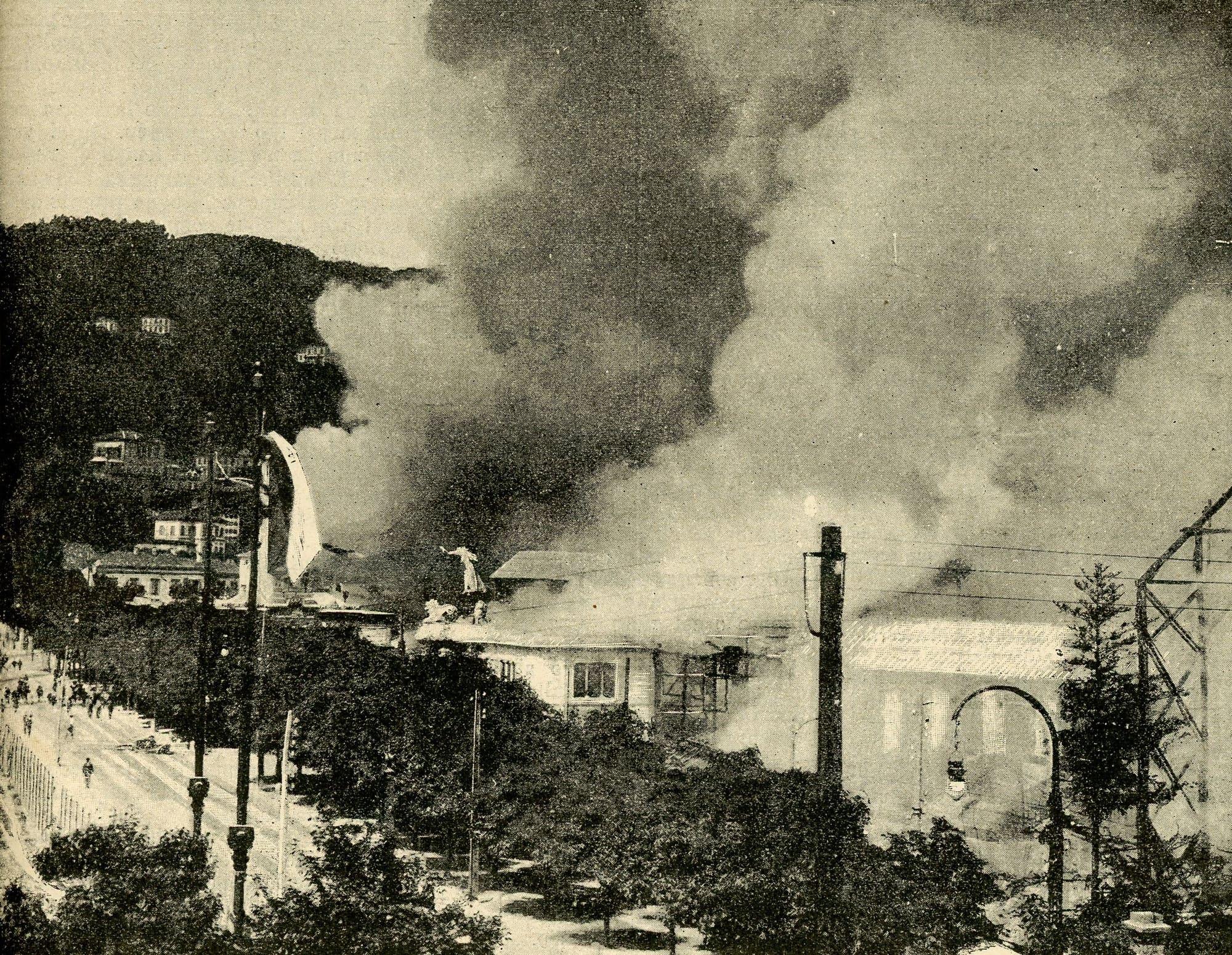
On 8 July 1899 a spark from two electric wires touching set fire to the pavilions, which were made of wood, and destroyed them in less than an hour; only the art pavilion survived, because it stood apart from the rest. Many of Volta's relics and original instruments, lent for the exhibition, were lost in the blaze, and only some were saved. A subscription was opened at once, to which the king also contributed, and within a month Linati had rebuilt everything, with the two side wings straight instead of curved to save time. The exhibition reopened on 20 August and closed on 5 November, after a hundred and seventy days and more than a hundred and ninety-three thousand paying visitors.
1927, the physicists and the Tempio
For the centenary of his death, in 1927, Como wanted a celebration grander than that of 1899. The exhibitions were held at Villa Olmo: hydroelectric industry, telephony and telegraphy, silk. On the hill of San Maurizio, above Brunate, the postal, telegraph and telephone workers had the Faro Voltiano built, a lighthouse inaugurated on 8 September. From 11 to 20 September the International Congress of Physicists met, with sixty-one participants, in Como, Pavia and Rome, among them the young physicists of quantum mechanics: Wolfgang Pauli was twenty-seven, Franco Rasetti twenty-six, Werner Heisenberg, Enrico Fermi and Paul Dirac twenty-five. Albert Einstein stayed away, because of his firm opposition to Mussolini's regime. At the congress Niels Bohr stated the principle of complementarity for the first time, and Fermi presented his quantum theory of the ideal gas. The Como sessions were held in the science hall of the Istituto Carducci, where the painter Achille Zambelli later painted medallions with the names of the delegates on the walls: it is known as the Sala dei Nobel.
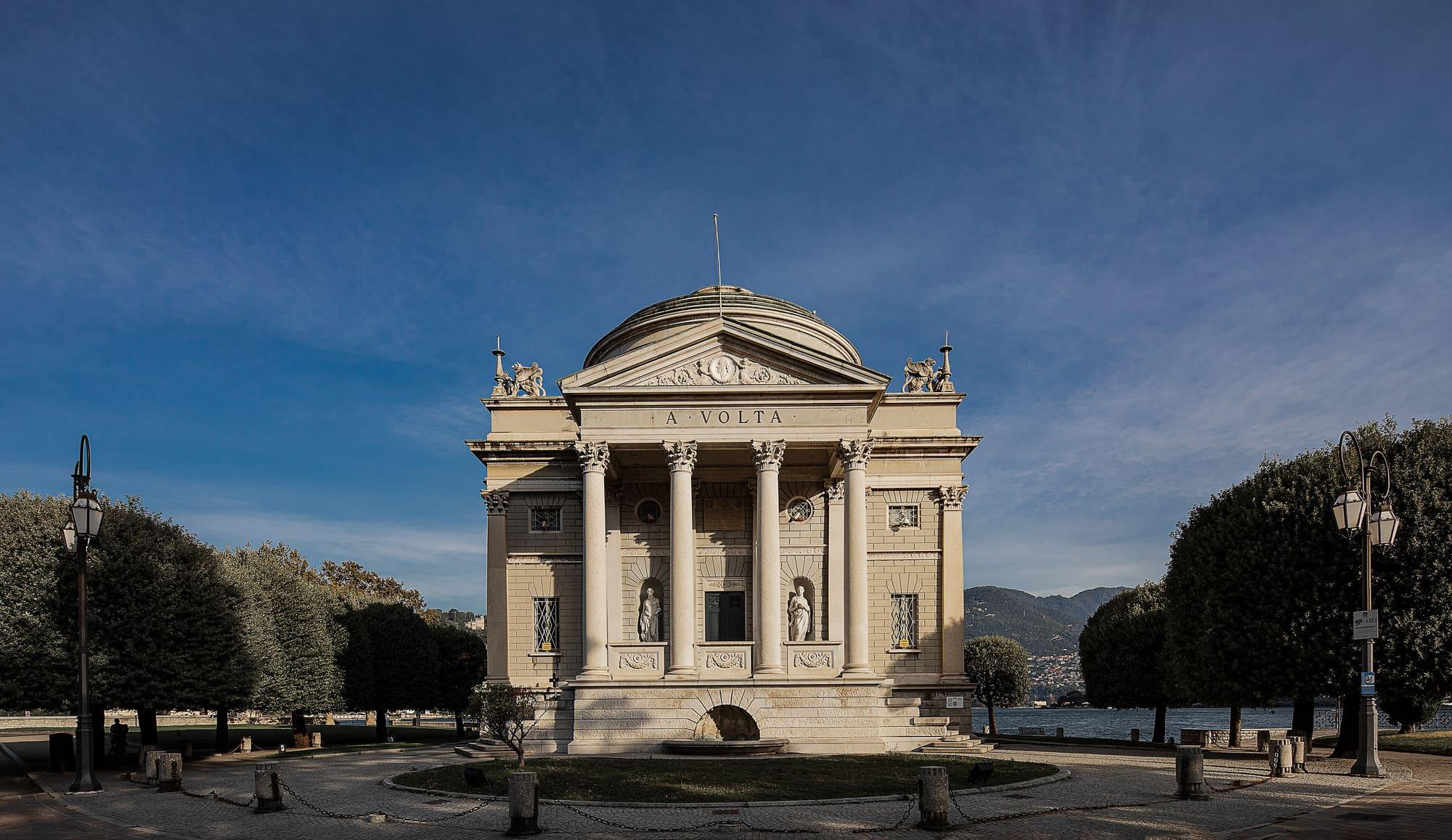
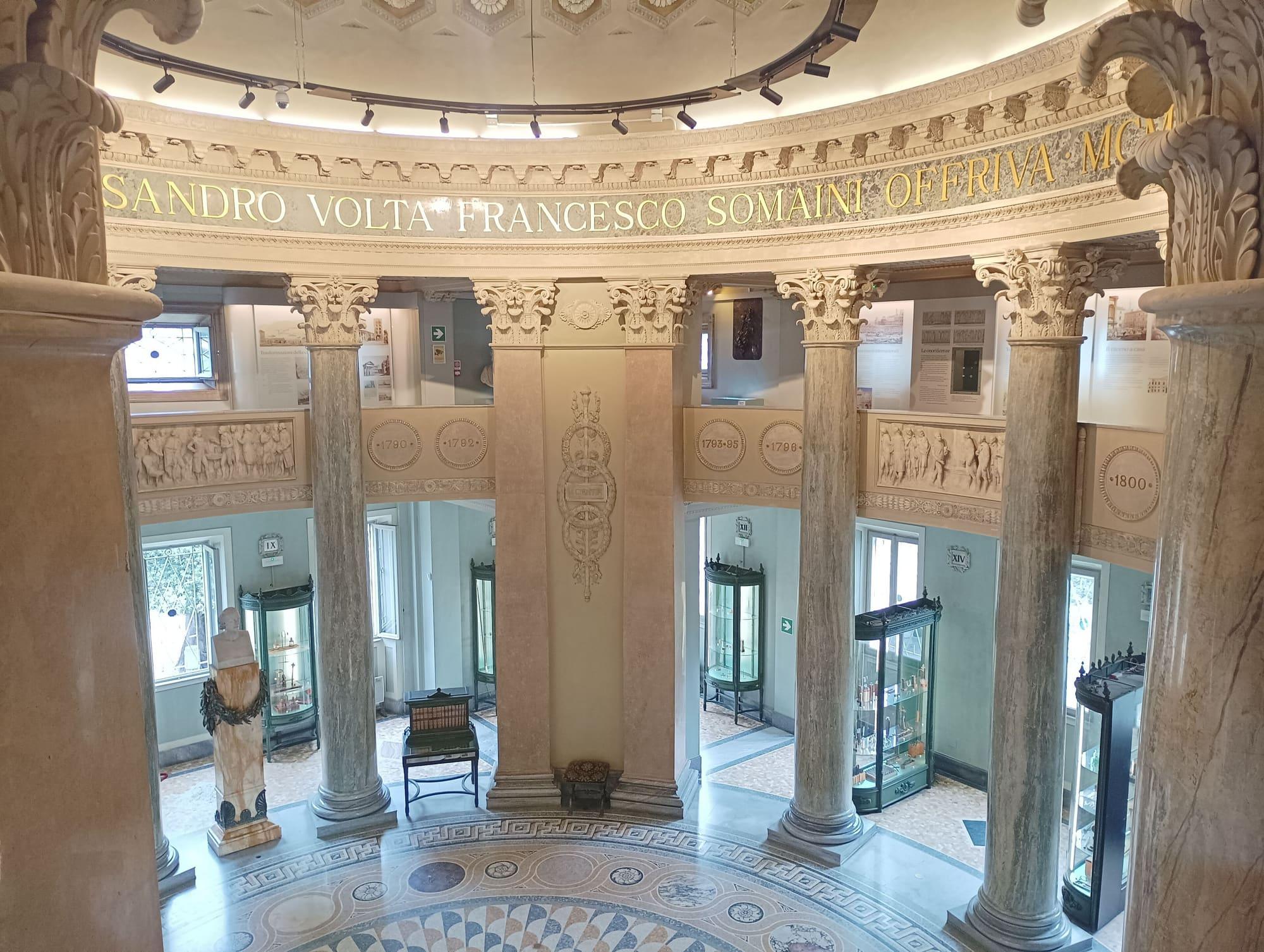
The lasting monument of that centenary is the Tempio Voltiano. The industrialist Francesco Somaini conceived it, paid for it and gave it to the town, and the architect Federico Frigerio designed it in the neoclassical style, with an explicit reference to the Pantheon; it was inaugurated on 16 July 1928. It is a square building on a high base, fronted by a vestibule with two symmetrical flights of steps, with a drum and a hemispherical dome opened by an oculus; inside, a circular gallery runs round the central hall and looks down into it like a balcony. The plinth, more than two metres high, was meant to protect it from the lake's floods; the facing is Aurisina limestone from the Karst. The statues of Science and Faith beside the entrance are by the twins Carlo and Luigi Rigola, and the reliefs of Volta's life inside are by the Como sculptor Pietro Clerici. The Tempio holds original instruments of Volta's and reconstructions: on the ground floor the apparatus, from the battery to his studies of electricity and gases; in the gallery Volta the citizen, with his family, his ties to the town, his offices and honours.
What remains
The Tempio has even been on a banknote: from 1984 the ten-thousand-lire note carried Volta's portrait and, on the back, the Tempio, and one of those notes is displayed in its cases. One of the Tempio's column batteries was reproduced in 1956 for the National Museum of Science and Technology in Milan, and another copy of the battery is kept in Pavia, in the museum of the university where Volta taught. In Piazza Volta stands the statue by Pompeo Marchesi, of 1838. At Camnago Volta is his tomb, the small round temple that his widow and sons had built in 1831 to a design by Melchiorre Nosetti, with the dedication on the pediment: Ad Alessandro Volta la Vedova e i Figli, to Alessandro Volta, his widow and sons. On the lakefront, since 2015, stands Life Electric by Daniel Libeskind, a tribute to Volta.
Historical events linked to this story are collected in the Lake timeline.