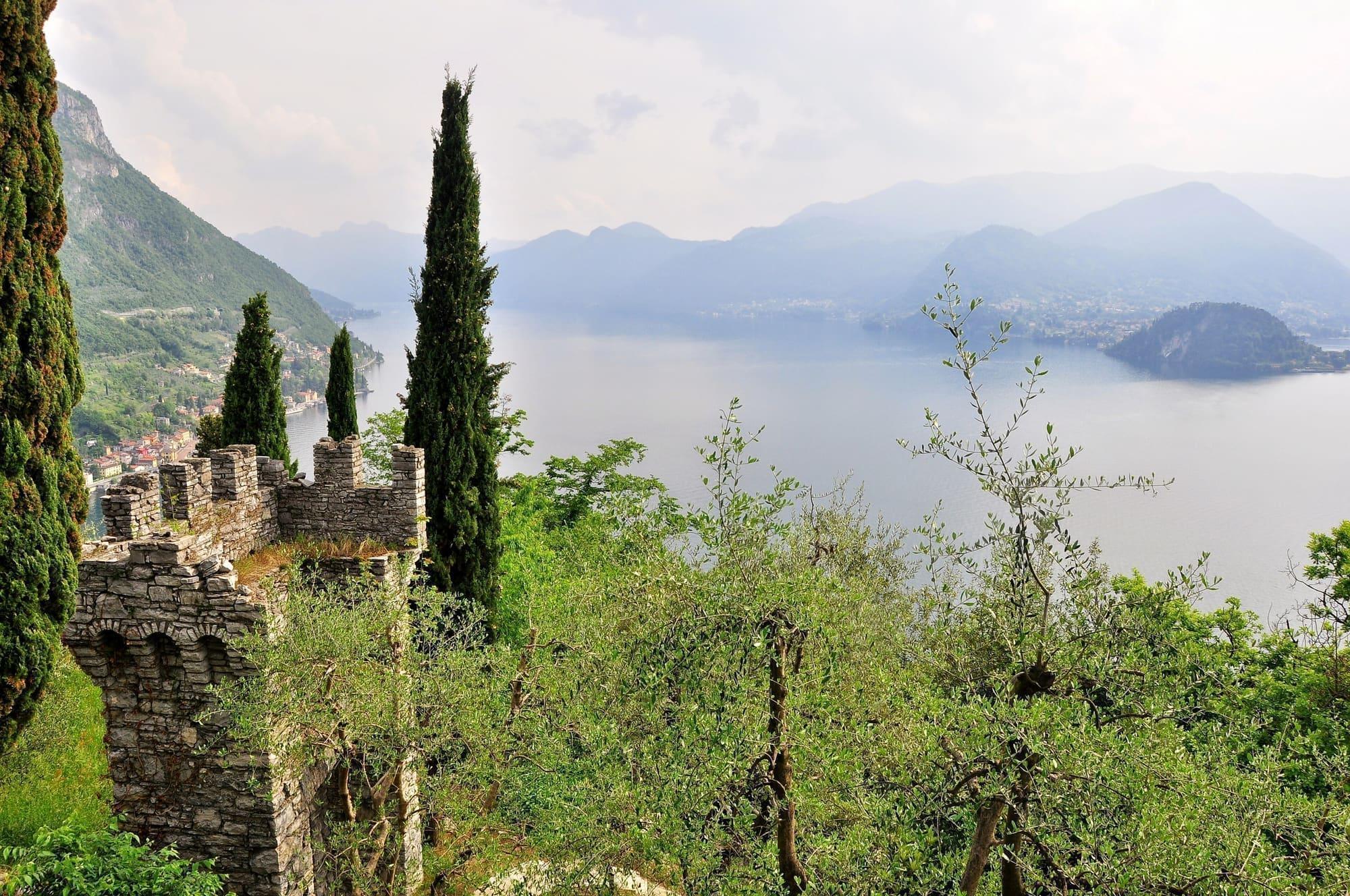
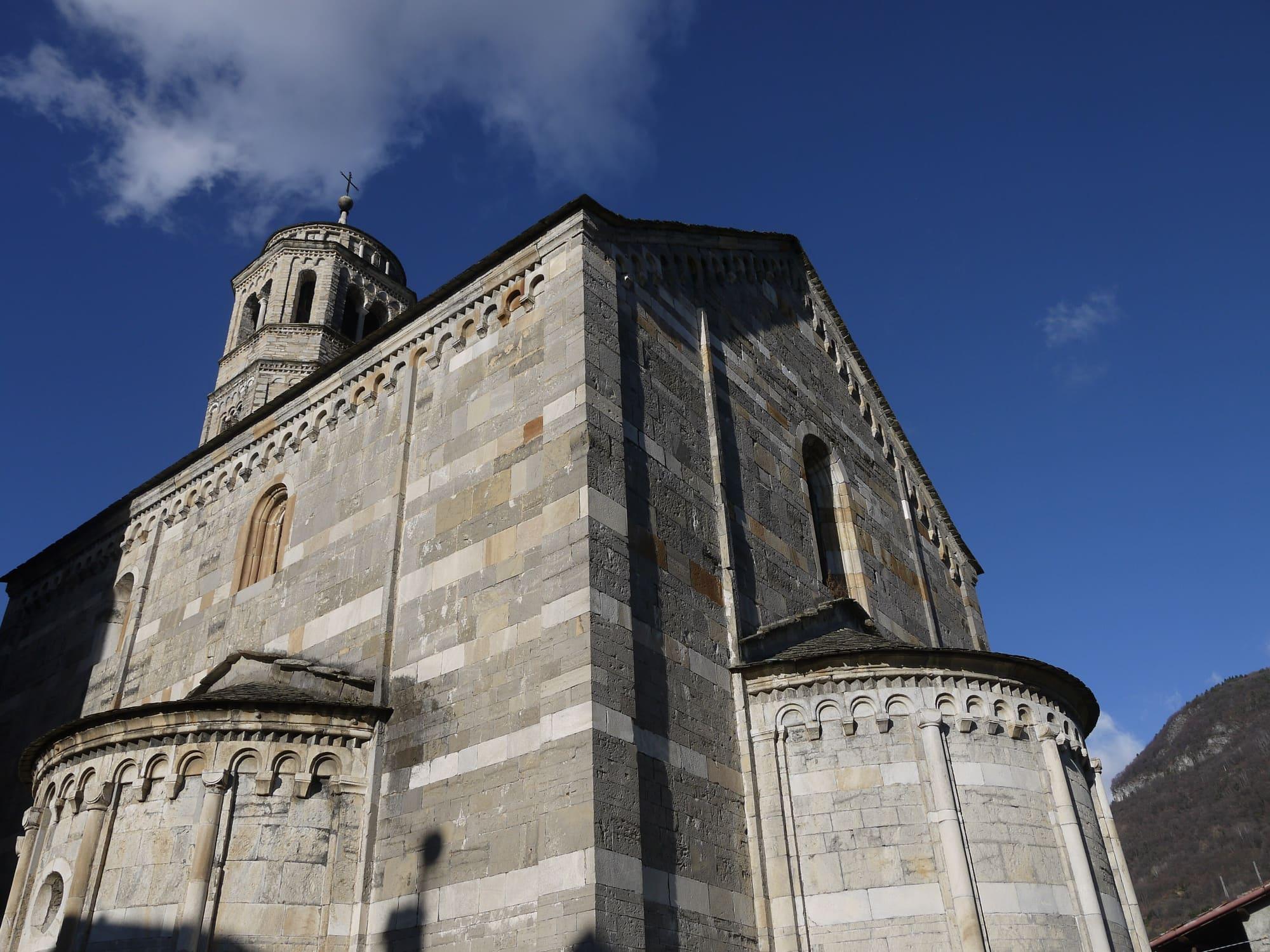
Many of the lake's churches are built of stone quarried on its own shores, and each stone bears the name of the village it comes from: the white marble of Musso, the grey stone of Moltrasio, the black marble of Varenna and Olcio. It was cut along the shores, travelled by water aboard the comballo, the lake's cargo boat, and can be seen today in Como Cathedral, in the Broletto and in the Romanesque churches of the villages.
The oldest is Musso marble. It is white or grey, medium to coarse grained and very compact; a greyer variety, bardiglio, looks much like Carrara marble, and small green crystals of fuchsite glint in it here and there. It occurs in bands within the gneiss of the upper lake, between Musso and Dongo on the western shore and between Piona and Olgiasca on the eastern one. The main quarries, now abandoned, were in the upper part of Musso, on the same spur as the Medeghino's castle, and together with the demolitions they consumed its ruins. The Romans already used it: the sixteen columns of San Lorenzo in Milan, about seven and a half metres tall and taken from Roman buildings of the second or third century, are Musso marble. Como used it in the Middle Ages and the Renaissance for its most important civic buildings, and in the twentieth century Giovanni Muzio took it up again in Milan for the Tempio della Vittoria (1927–1930) and the Bonaiti-Malugani houses (1935–1937).
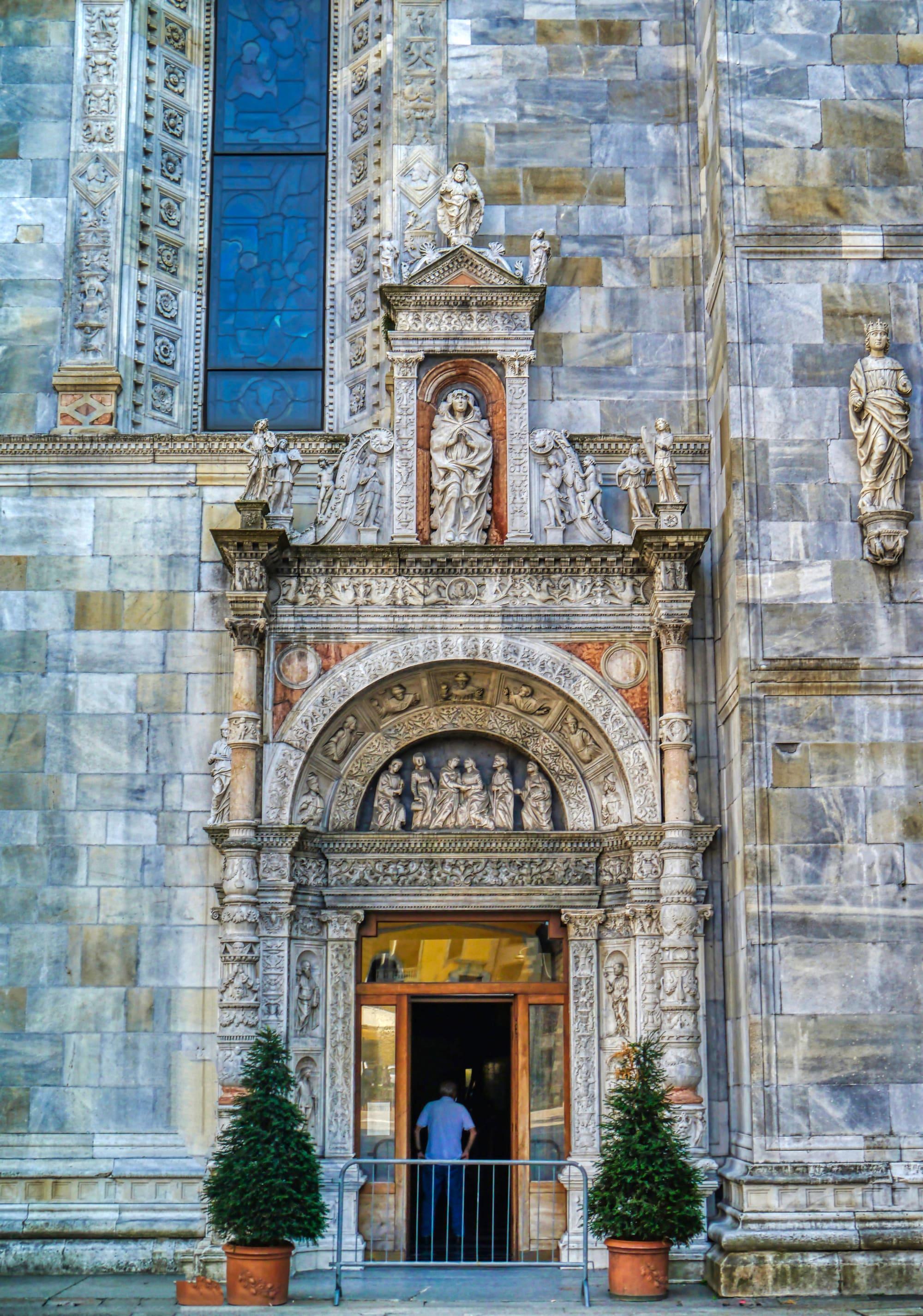
The front of the cathedral
In Como, Musso marble became the stone of the cathedral. Building had begun with another: the first piers, those at the far end of the aisles, are the only ones in black Olcio marble. From 1452 Musso marble took over and became the main material, both structural and decorative; 1452 is also the oldest date carved in the building, on the first pier on the right as you enter by the Porta della Rana. The facade, begun in 1457 and completed in 1486 with the rose window, is Musso marble, as are the octagonal basin of the fifteenth-century font, the painted altarpiece of the altar of Sant'Ambrogio, of 1482, the oldest in the cathedral, and the altarpiece of the Passion, carved by Tommaso Rodari in 1492 and left uncoloured. The black stone returns later as Varenna marble: in the twisted columns of the altar of the Assumption, designed by Francesco Maria Richini before 1641, and in the eighteenth-century floor of the Canons' sacristy, patterned in white Musso, black Varenna and red Arzo marble.
The stone of Moltrasio
Further south, in the first basin, the stone was grey. Moltrasio limestone is a Jurassic rock, dark grey with hazel-coloured patinas, in beds from a few centimetres to more than half a metre thick, in which ammonites, some of them large, are often found. It takes its name from the village, and the municipal coat of arms remembers it: the gold field stands for the wealth and fame the villagers earned by quarrying it, and in the first coat of arms, drawn in 1909, the mountains were black, the colour of the stone. The name of Carate, a little further north, is thought to come from a Celtic word for a place of stone, after quarries worked since antiquity. It was not a luxury stone: in the eighteenth century Anton Gioseffo Della Torre di Rezzonico wrote that the more crumbly kind, hardened by the air, was used to roof houses, coarser than the slates of Lavagna and passed over by many, for its weight, in favour of tiles. But it is everywhere: in the walls of the church of San Giovanni on the Isola Comacina, in the floor of Santa Maria del Portico on the same island, and in the slabs of the roof of the oratory of San Fedelino, at the head of the lake.
The black of Varenna
On the eastern shore the stone was black. The black marble quarries are one of the sights along the Sentiero del Viandante. In 1824 the abbot Amoretti described this marble as hard and handsome, called occhiadino because it seems made of many eyes: blackish, with white spar that sometimes fills the hollows of the marine fossils left in the stone. Three years earlier Davide Bertolotti, in his Viaggio al lago di Como, had sailed close by the quarries and seen how they were worked.
Then we skirted the marble quarries, whose strata, hanging almost perpendicular over the lake, make the work of extraction awkward and perilous; so that you often see the workmen, tied in mid-air with ropes, striking the hard rock with their irons, suspended over the precipice.
Davide Bertolotti, Viaggio al lago di Como (1821)
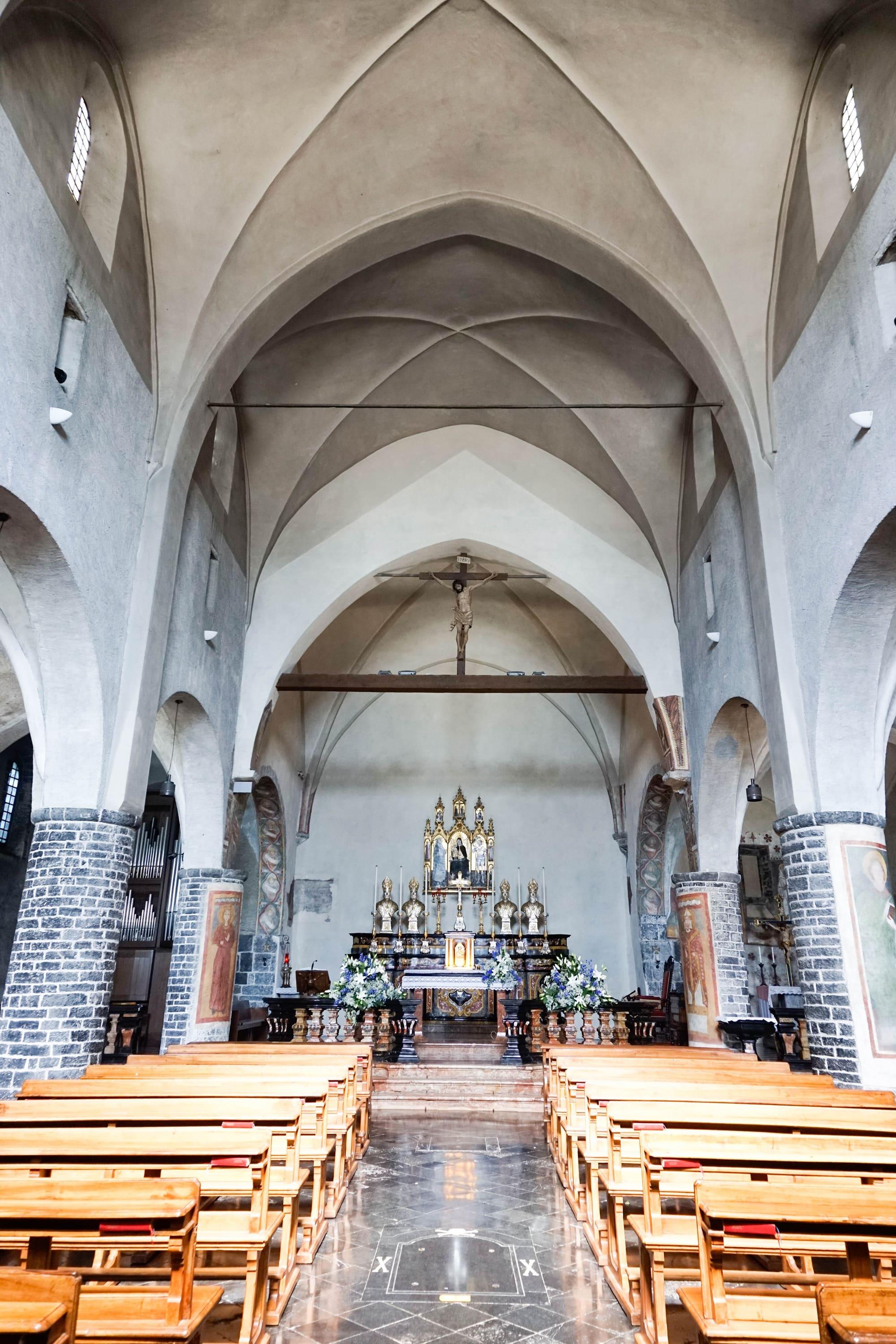
Varenna black marble was quarried in the territory of Perledo, between Varenna and Bellano, and also at Olcio, a hamlet of Mandello; another quarry was at Grumo, at the entrance to Lierna, later turned into a silk mill with a tall chimney. In Varenna the stone holds up the main church: the aisles of San Giorgio are divided by round columns of the local black stone. And the black travelled far. The quarries round the lake were essential to the Lombard tradition of sculptors, stonemasons and architects, fed by the long building of Milan Cathedral; in that cathedral's floor, designed by Pellegrino Tibaldi, begun in 1584 and completed only between 1914 and 1940, Varenna black alternates with the white and pink of Candoglia.
Black and white
Stones of different colours form bands in the walls of churches and public buildings around the lake. In Gravedona, Santa Maria del Tiglio was built of local stone, white Musso marble and black Olcio stone, which alternate in bands in its walls. In Como, beside the cathedral, the facade of the Broletto, the medieval town hall, is banded in white, grey and red marble: the white is from Musso, the grey from Moltrasio. At the head of the lake, by contrast, the stone was granite. San Fedelino granite takes its name from the little church at Novate Mezzola near the first quarry, opened at the end of the eighteenth century by stonecutters from the Val d'Intelvi. It paved streets, in Milan's Via Broletto and also in Sondrio, Como, Lecco, Pavia, Bologna and Verona, and it is now the reference sample, with the value one, for measuring how paving stones wear. In the eighteenth century the little church of San Fedelino served as a store for the workers of the nearby quarries.
On the water
For stone quarried on the shores, the road was the lake. The comballo, the Lario's cargo barge, already appears in a document of 1218 that forbade the boatmen of Lake Como to form partnerships to run ships and boats. It was twenty to thirty metres long, square in section, with a flat bottom of irregular planks and a single square sail on a fixed mast, to run before the wind; when the wind dropped it moved with four oars and a pole of six or seven metres pushed against the bottom. It was steered with a rough blade at the end of a pole some ten metres long, on the starboard side. It carried heavy loads, above all for building: Moltrasio stone, sand, lime and wood for the kilns. Fully laden, its side barely showed above the water, and wrecks were frequent, because it was loaded to the limit. To go down the Adda from Lecco to Milan the burchiello was used, much the same but with a mast that could be lowered to pass under bridges. A couple of comballi are still kept at Bellagio.
Historical events linked to this story are collected in the Lake timeline.